Salt Shed and Salt Storage Buildings
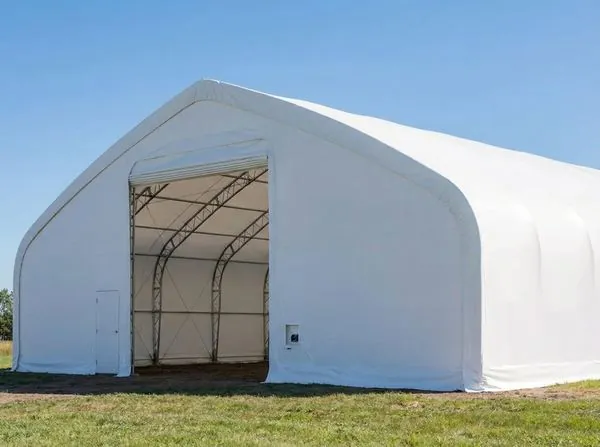
A salt shed is a covered building that keeps road salt, or a sand and salt mix, out of rain and snow until it is loaded out. A fabric building, a PVC cover over a galvanized steel frame, is one way to build one. MAX supplies the building kit in 23 published sizes; suitability for salt storage is confirmed for each project, not assumed from a standard model.
- Published prices
- Double-trussed galvanized frames
- Free delivery · 888 hwy km
- 12-year cover warranty
Free within 888 highway km of the supplying Edmonton/Brampton hub. Customer unloading unless otherwise stated.
Prefer help choosing? Ask a Building Advisor
Prefer to talk? Call 587-800-4629 · Text us
What is a salt shed?
A salt shed, or salt storage building, covers a stockpile of road salt or a sand and salt mix, with room for a loader and trucks to work. This page is written for municipal yards and winter maintenance contractors planning salt sheds.
Environment and Climate Change Canada’s Code of Practice for the Environmental Management of Road Salts lists coverage of salt piles and blended salt-sand piles among the practices to consider for salt storage, along with drainage management. Read the Code and your provincial requirements for what applies to your organization.
What does MAX supply for a salt storage building?
MAX supplies the building kit: a double-truss galvanized steel frame and a PVC cover, 750g on the 30′–70′ range and 900g on the 80′ Industrial Series, with supplied hardware, anchoring and assembly instructions. The supplied ground stakes are hot-dip galvanized. The pad, any block or concrete walls, drainage and containment are not part of the kit; they are designed for the site by your project team. The MAX Standard sets out the building specification.
How does the building hold up around salt?
Salt is corrosive, and MAX does not publish a corrosion life or a chemical-resistance rating for salt storage. Galvanizing reduces corrosion risk but does not eliminate maintenance. For salt or other corrosive storage, ask for the material and coating information for your selected building and the cleaning and maintenance requirements that go with it. Suitability is confirmed for each project.
Keep the pile off the cover and the frame. The cover is a weather barrier, not a containment wall, so any wall that holds the pile has to be designed as part of the project.
Which sizes fit a salt shed?
A nominal footprint does not establish how much salt a building holds. The usable geometry, the pile arrangement and the loading method have to be established for the actual proposal. Start from the truck and the loader: the door they pass through and the height they need to work.
- 40′ × 60′ × 23′: 40′ wide, 60′ long, 23′ nominal peak.
- 50′ × 80′ × 23′: 50′ wide, 80′ long, 23′ nominal peak.
- 60′ × 100′ × 25′: 60′ wide, 100′ long, 25′ nominal peak.
- 70′ × 100′ × 28′: 70′ wide, 100′ long, 28′ nominal peak.
- 80′ × 104′ × 37′: 80′ wide, 104′ long, 37′ nominal peak. The 80′ Industrial Series, with a 900g PVC cover.
The height at the peak is not the clearance at the doorway or sidewall. See the product page for the current price and the published dimensions, ask for the supplied drawings before fixing a layout, or see all 23 sizes.
What foundation or anchoring does a salt shed need?
It depends on the building, the ground and the design. The anchoring guide describes wedge anchors into concrete and precast blocks with wedge anchors as approaches to discuss. Raising a building on blocks changes its geometry and connections and must be included in the project assessment. Foundation and anchoring design must be identified in the quotation. See fabric building engineering for how drawings and site-specific review are arranged.
What should a tender or request for quotation include?
State the location, the use, the required documentation, the foundation scope, utilities and approvals. Ask each bidder to identify exclusions, assumptions and any design services separately. Planning fabric buildings for municipal storage covers the procurement scope, and the quote checklist helps you compare bids on the same scope.
How does delivery work?
MAX arranges release from the supplying hub and transport to your yard. Delivery is free within 888 highway km of the Edmonton or Brampton (Toronto-area) hub supplying your order, and is quoted before ordering beyond that. Unloading is the customer’s responsibility unless your written quote states otherwise. See delivery and pickup.
Who installs the building?
Installation can be quoted for your building and location. Confirm crew availability, equipment, travel, site preparation and anchoring requirements in the written scope. Winter installation depends on ground conditions, access, the specified anchoring method and crew availability. See how a fabric building is installed.
What warranty applies?
MAX publishes a 2-year manufacturing and material defect warranty and a 12-year limited fabric cover warranty, with fabric coverage prorated after year two. The written terms define coverage, remedies and exclusions, and the fabric warranty is not a prediction of service life. Read the warranty and confirm how it applies to your intended use before purchase.
How do I get a price?
Kit prices are published for every size. See the product page for the current price, or the cost guide for all 23 sizes. The kit price is not the finished facility: site work, walls, installation and professional services are identified separately. For a quote, open the Building Advisor form at the top of this page: choose a size, give your delivery town or postal code, and MAX confirms the building, the delivery scope and the next step. You can also call or text 587-800-4629, Monday to Friday, 8am to 5pm Mountain Time.
Frequently asked questions
How much salt does a building hold?
A nominal footprint does not establish salt capacity. The usable geometry, material properties, loading arrangement and project requirements must be established for the actual proposal.
Is the steel frame protected against salt?
The frame is galvanized steel. MAX does not publish a corrosion life or a chemical-resistance rating for salt storage. Galvanizing reduces corrosion risk but does not eliminate maintenance, and suitability is confirmed for each project.
Can the salt pile rest against the fabric?
Do not plan on it. The cover is a weather barrier, not a containment wall. Any wall that holds the pile has to be designed as part of the project.
Does a standard MAX model meet municipal requirements?
The selected configuration and site requirements need confirmation. No municipality-wide suitability claim is made here.
Does the kit price include the pad and block walls?
No. Only the written quoted scope is included. Site work, installation, utilities and professional services must be identified separately where applicable.
Prepare your project brief · Read the order and deposit terms · Read the warranty