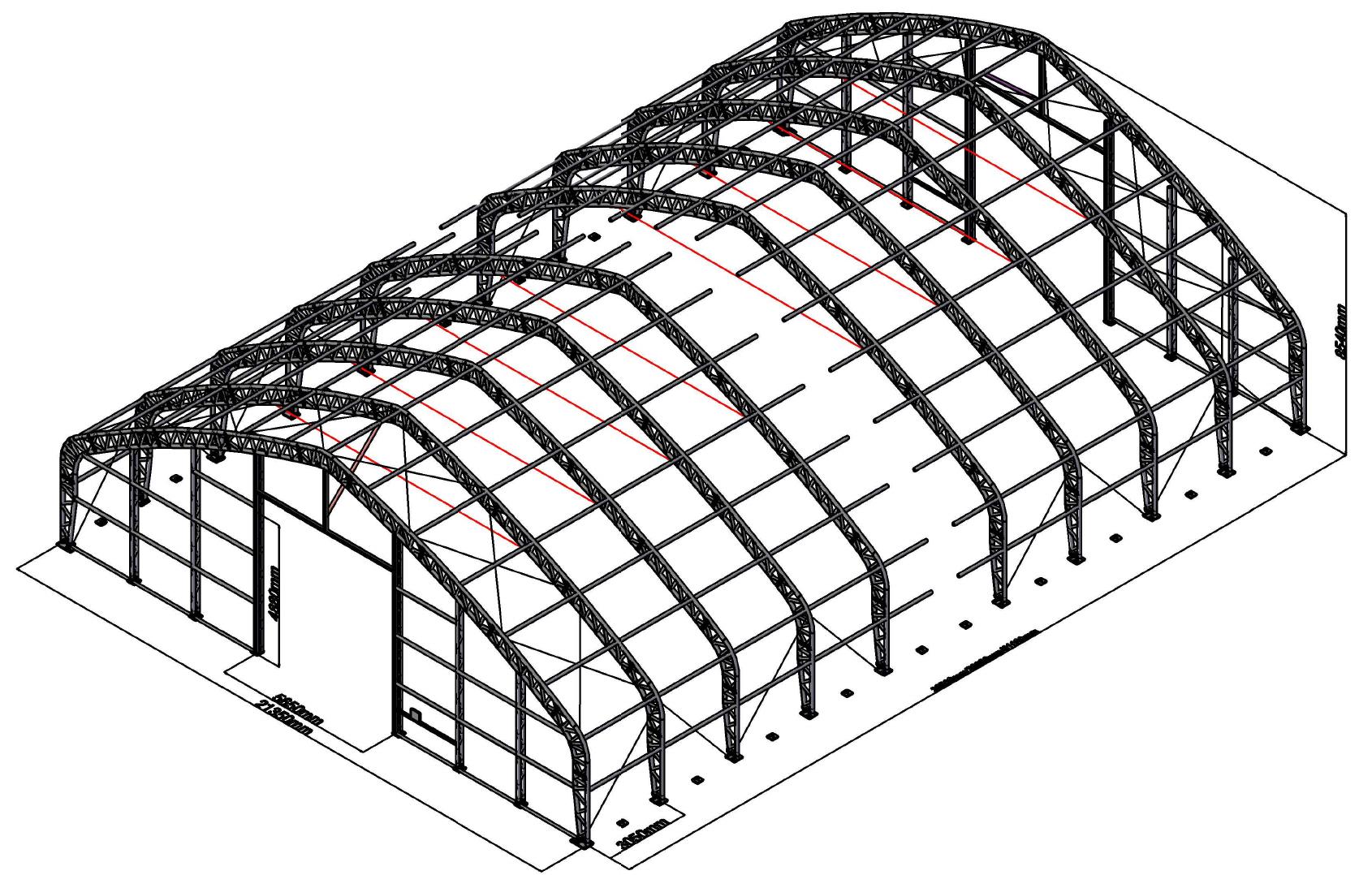
When comparing fabric storage buildings, the frame design is often the most important differentiator between budget and premium options. The choice between a single-truss and double-truss frame has a profound impact on structural strength, longevity, and overall building performance.
What Is a Double-Truss Frame?
A double-truss frame consists of two parallel galvanized steel tubes connected by a series of crossbeams. Each truss is essentially two structural members working in concert, bolted together at regular intervals to create a unified frame element. The result is a frame with significantly greater strength and stiffness than a single tube of equivalent material.
Why Two Is More Than Twice as Strong
Structural engineering provides a clear explanation for why a double-truss frame is more than twice as strong as a single-truss frame, despite using approximately twice the steel.
The key concept is moment of inertia — a measure of a structural member’s resistance to bending. When two parallel tubes are connected by crossbeams and separated by a gap, the combined moment of inertia is dramatically higher than the sum of the individual tubes. This is because the crossbeams force the two tubes to act as a single deep member, and bending resistance increases with the cube of the effective depth.
In practical terms, a double-truss with tubes spaced six inches apart can have three to four times the bending resistance of a single tube, despite containing only twice the steel. Add in the structural redundancy — if one connection point is overloaded, the parallel member and adjacent crossbeams redistribute that load — and the effective strength exceeds what simple doubling would predict.
Load Distribution
A single-truss frame concentrates loads along a single line. Any snow, wind, or dead load on the roof is channelled through one tube at each truss location. If that single tube develops a weakness — a dent from equipment contact, corrosion at a bolt hole, or a manufacturing inconsistency — the entire truss is compromised.
A double-truss frame distributes loads across two parallel paths. The crossbeams transfer forces between the tubes, so a localized weakness in one tube is compensated by the other. This redundancy is the same principle that makes a two-engine aircraft safer than a single-engine one — the system continues to function even if one component is degraded. Understanding this engineering advantage is key when evaluating fabric storage buildings.
Resistance to Twisting
Single tubes are susceptible to torsional loading — twisting forces caused by uneven wind loads or asymmetric snow accumulation. A single round or square tube has relatively low torsional resistance. A double-truss frame, with its two tubes connected by rigid crossbeams, resists torsion far more effectively because the two tubes and crossbeams form a closed or semi-closed section that inherently resists twisting.
Connection Strength
The points where trusses connect to base rails, purlins, and other components are often the weakest links in a frame system. Double-truss frames provide two connection points at every junction instead of one, doubling the fastener count and distributing connection loads across a wider area. This reduces the stress on individual bolts and makes the connections less susceptible to failure under extreme loads.
Real-World Implications
The engineering advantages of double-truss frames translate directly to building performance. Buildings with double-truss galvanized steel frames maintain their shape better over time, resist deformation from wind and snow loads more effectively, and have a longer structural service life than single-truss alternatives.
For anyone investing in a fabric building intended to last decades, the frame is where the money should go. Covers can be replaced. Hardware can be tightened. But the frame is the foundation of the entire structure, and a double-truss design provides the structural margin that makes the difference between a building that performs for 30 years and one that shows signs of fatigue in 10. This is reflected in the total cost of ownership over time.
Frequently Asked Questions
Why is galvanized steel important for building frames?
Galvanized steel is coated with zinc through a hot-dip process that provides decades of corrosion protection. In Canada's harsh climate with freeze-thaw cycles, road salt exposure, and agricultural chemical environments, ungalvanized or painted steel frames can begin rusting within years. Galvanized frames maintain structural integrity for 25+ years, far outlasting painted alternatives.
What's the difference between double-truss and single-truss frames?
Double-truss frames use two structural members at each truss point instead of one, effectively doubling the load-bearing capacity at critical stress points. This allows for higher snow and wind load ratings without increasing the building footprint. MAX Storage Buildings use double-truss engineering on all models, which is why our load ratings exceed many competitors' single-truss designs.
How long does a galvanized steel frame last?
A properly galvanized steel frame in Canadian conditions typically lasts 25–40 years depending on the environment. Agricultural environments with ammonia and chemical exposure may reduce this to 20–25 years, while dry storage applications can see frames last 40+ years. The frame will outlast multiple PVC covers, making cover replacement the primary long-term maintenance cost.
Ready to Protect Your Investment?
Explore our range of heavy-duty fabric storage buildings — 18 sizes from 20' to 70' wide. Our 50' × 100' model provides excellent capacity for most operations.
Browse Buildings Get Approved for Financing Get a Quote